
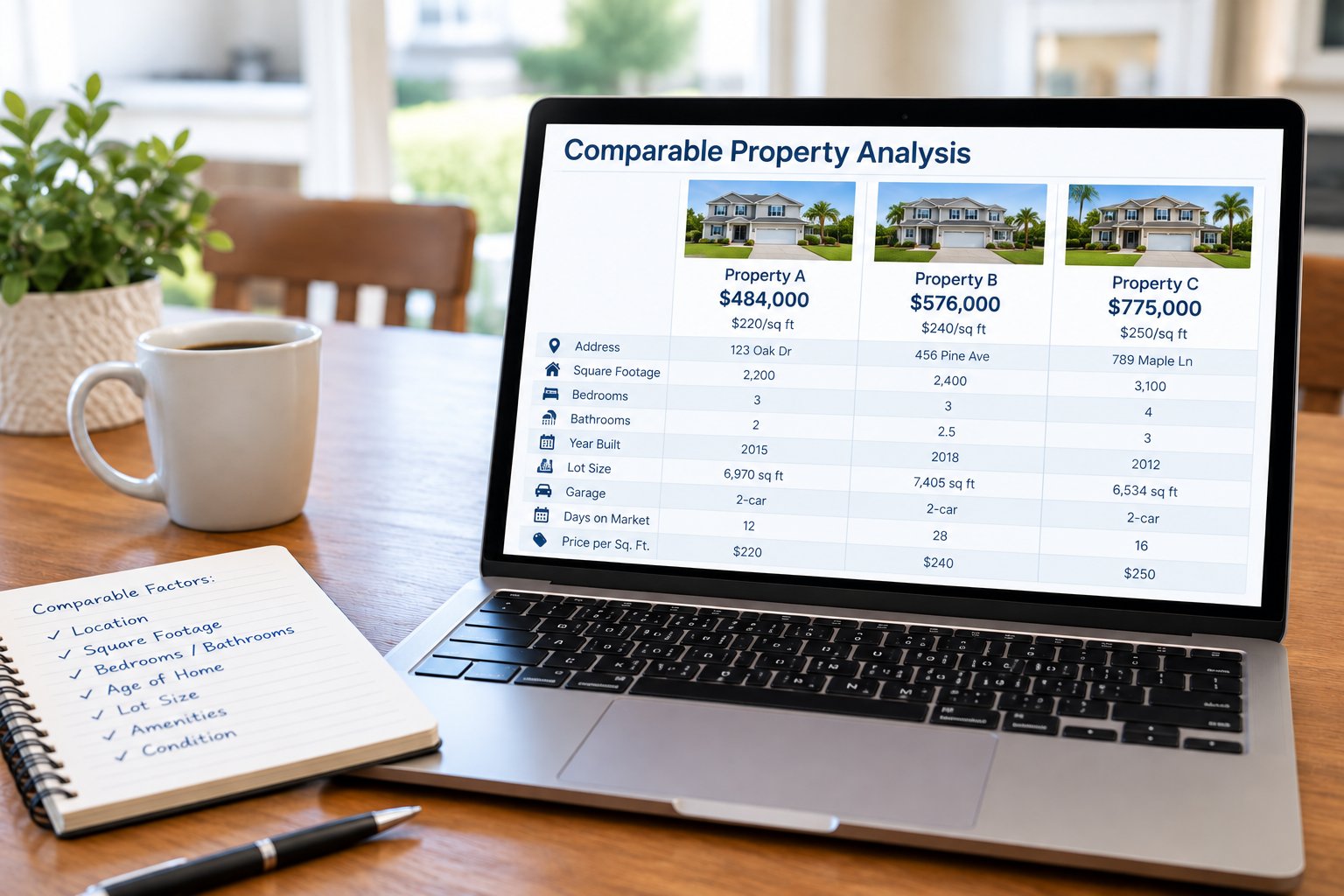
Pricing Your Home From Recent Sales
Every seller starts with a number in mind. It comes from a neighbor's sale, a website estimate, or what you need to clear after the mortgage. None of those is evidence. What a buyer will pay today is written in what other buyers paid recently, for homes like yours, near you.
Here is how to read those sales the way an appraiser and a good agent do.
What makes a sale comparable
Not every nearby sale tells you something. The ones that do share most of this:
- Close by. Same subdivision when possible, otherwise the same few streets, and always the same school zone. Half a mile can be a different market in Tampa Bay.
- Similar size and layout. Within about 10% of your square footage, with the same bedroom and bathroom count. A three bedroom and a four bedroom are different products, not the same product at different prices.
- The same type of home. A single-family home is not a villa, and neither is a townhouse. A condo's floor, view, and building matter as much as its size.
- Similar age and condition. A renovated kitchen and a 1998 kitchen are different homes at the same square footage.
- Recent. Three months is ideal, six is usable, and anything older tells you about a market that no longer exists. Interest rates alone have moved enough this year to change what buyers can pay.
- An arm's-length sale. A sale between family members, or a home bought sight unseen by an investor, is not evidence of market value.
Three to five sales like that are worth more than twenty that merely share a zip code.
Adjusting for the differences
No two homes match exactly, so each comparable gets adjusted toward yours. If the sale had a pool and you don't, its price comes down before you compare. If yours has a three-car garage and it had two, that one adjusts up.
Things worth adjusting for in Tampa Bay:
- A pool, a fenced yard, or a screened lanai
- Garage spaces
- Waterfront, water view, or a conservation lot
- Age and condition of the roof, the AC, and the kitchen
- Lot size, and whether the lot backs to a road
- Impact windows and other hurricane protection, which affect the buyer's insurance quote
- A CDD fee in one community and not the other, which changes what the buyer pays monthly at the same price Our guide to CDD fees covers how to find the amount for any address.
- Whether the sale included seller-paid closing costs, which makes the recorded price higher than what the seller netted
That last one matters more in a market where sellers are helping with costs. Two homes can record the same sale price and mean very different things.
What list prices tell you, and what they don't
An asking price is a seller's opinion. It becomes evidence only when a buyer agrees to it.
Still, active listings are worth studying, because they are what your home competes against. Look at how long each has been listed and whether the price has been cut. A home that has been sitting for two months at $475,000 has told you something useful: not that the home is worth $475,000, but that buyers so far don't think so.
Two numbers are worth pulling for your own street:
- Days on market for homes that sold, and for homes still sitting.
- Sale price as a share of original list price. When that number drifts below 95%, sellers are starting high and negotiating down, which costs time.
Our market reports publish both for all four counties, every other Monday.
Why the first two weeks decide the rest
A new listing gets its biggest audience in its first week or two. Everyone who has been watching that neighborhood, and every buyer whose agent has a saved search, sees it at once.
Price it right and that audience produces showings, and showings produce offers. Price it high and the same audience passes, the listing goes quiet, and the buyers who come later see a home that has been sitting. Then the price cuts start, each one telling the market to wait for the next.
Sellers who start close to the recent sales usually get more, and get it faster, than sellers who start high and chase the market down.
One more reason not to stretch
If your buyer is financing, their lender will order an appraisal, and the appraiser works from the same recent sales you should be working from. A contract above what those sales support can come back short.
Then the deal reopens: the buyer brings the difference in cash, you come down, or it falls apart. That conversation happens four weeks in, after your home has been off the market and you have planned a move around it.
What we do
Our pricing work is one afternoon of reading the same sales, adjusting each one against your home, and looking at what is currently for sale around you. What you get back is a range rather than a single number: a price where your home sells quickly, a price where it sells with patience, and the point where it sits.
You can start with our buyer payment calculator. Monthly payment is the number that most buyers are shopping for.
If renting is also on the table
Some owners weigh selling against keeping the home as a rental. If that's you, our sister company Tampa Bay Rentals covers how much rent a Tampa Bay home will bring, and it's the same kind of work: comparable homes research and analysis.
One thing we don't recommend: listing a home for sale with a tenant still living in it. Showings are harder to schedule, tenants have little reason to help, and the sale usually takes longer. If the home is rented, the cleaner path is to list it after the lease ends.
Talk it through with us
Send us the address and we'll put together the recent sales, the adjustments, and a price range, with the reasoning attached. Get in touch and we'll go through it together.
FAQs
How many comparable sales do I need?
Three to five good ones. A close match in the same neighborhood, sold in the last three months, is worth more than a dozen loose matches across town.
How far back can a sale still count?
Three months is ideal, and six is usable if the market has been steady. Older than that and the buyers who set that price were shopping with different interest rates and different competition.
Is a Zestimate or an online estimate accurate?
Treat it as a starting range. An automated estimate can't see your roof's age, your renovated kitchen, or the three similar homes listed on your street right now. It also doesn't know whether a recorded sale included seller-paid closing costs.
Should I price high to leave room to negotiate?
It usually costs more than it makes. The first two weeks bring the most buyers, and a price above the recent sales sends them elsewhere. Sellers who start near the evidence tend to net more, and sell faster, than sellers who start high and cut later.
What happens if the appraisal comes in below the contract price?
The lender will lend against the appraised value, so the gap has to be closed: the buyer pays the difference in cash, the price is renegotiated, or the contract ends. Pricing from recent sales is how you avoid that conversation.
Does a pool add what it cost me?
Almost never. A pool helps a home stand out and can raise the price, and the increase is usually a fraction of what it cost to install. The same is true of most big-ticket upgrades.